
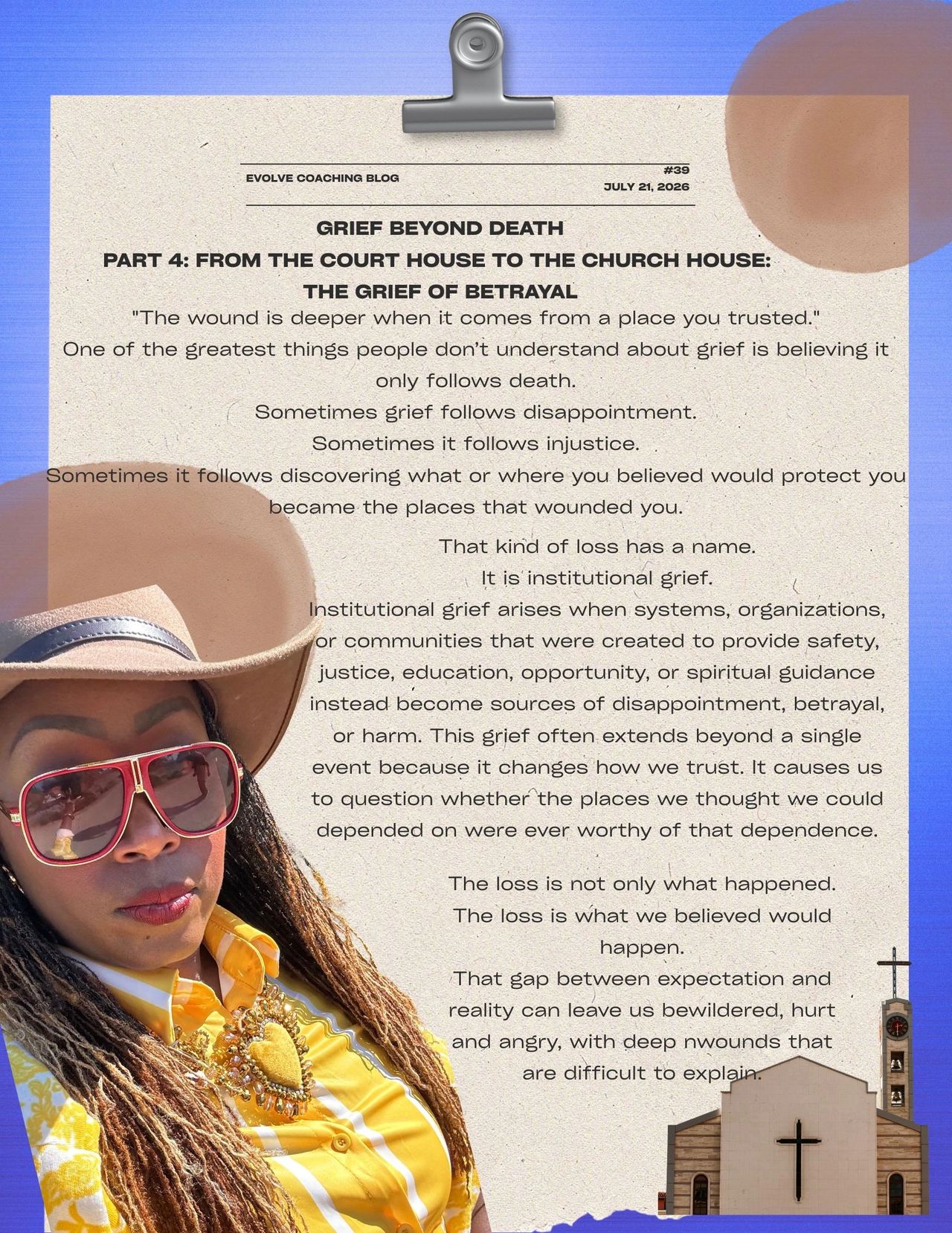
Grief Beyond Death
Part 4: From the Court House to the Church House: The Grief of Betrayal
By Zykina Stewart, M.A. Certified Advanced Grief Recovery Method Specialist® Certified Grief Coach, Life Coach, Communication Coach, and Christian Coach
"The wound is deeper when it comes from a place you trusted."
One of the greatest things people don’t understand about grief is believing it only follows death.
Sometimes grief follows disappointment.
Sometimes it follows injustice.
Sometimes it follows discovering what or where you believed would protect you became the places that wounded you.
That kind of loss has a name.
It is institutional grief.
Institutional grief arises when systems, organizations, or communities that were created to provide safety, justice, education, opportunity, or spiritual guidance instead become sources of disappointment, betrayal, or harm. This grief often extends beyond a single event because it changes how we trust. It causes us to question whether the places we thought we could depended on were ever worthy of that dependence.
The loss is not only what happened.
The loss is what we believed would happen.
That gap between expectation and reality can leave us bewildered, hurt and angry, with deep nwounds that are difficult to explain.
When Trust Is Broken
Most of us grow up believing in institutions.
We are taught that courts pursue justice.
Schools cultivate factual learning and care.
Workplaces reward hard work.
Churches reflect the heart of God.
Understand that many people have experienced these institutions in healthy and life-giving ways, others have encountered moments where those same institutions fell painfully short of their purpose. Those experiences can leave lasting grief.
Perhaps you walked into a courtroom believing truth would prevail but left knowing that everyone did not received the same opportunity to be heard or seen, nor all the information.
Perhaps you attended a school where parts of history, culture, or lived experience were ommitted or minimized, leaving you feeling unseen or misunderstood.
Perhaps you gave your loyalty to a workplace only to discover that politics, favoritism, or profit carried more weight than integrity.
Perhaps you walked into a church searching for healing and left carrying another wound.
The details may differ.
The grief often sounds remarkably similar.
"I trusted this place."
"I believed these people."
"I thought I was safe."
The Weight We Carry Together
Institutional grief is rarely experienced in isolation, we carry it as a community.
Many minorities have lived with generations of stories about unequal treatment, barriers, and disappointments that shape how institutions are viewed. Whether every individual experience is the same is not the point. The cumulative weight of these stories influences trust, expectations, and emotional responses across generations.
Grief accumulates.
Each disappointment rarely stands alone.
One experience reminds us of another.
One headline awakens another memory.
One verdict recalls another story.
One policy reminds someone of another door that was closed.
Eventually the grief becomes larger than any single event.
This is why many people find themselves emotionally exhausted by the news.
Sometimes we wonder why one headline affects us so deeply.
The answer is often simple. It isn't just today's story.
It is every unresolved story that today's story awakens.
The Church Should Be Different
As a Christian, this section is perhaps the hardest for me to write.
Because I love the Church.
Not simply the building.
The people.
The Body of Christ.
The mission Jesus established.
I also recognize that for many people, church has become one more place connected to grief.
Some have experienced judgment instead of compassion.
Silence instead of advocacy.
Control instead of service.
Abuse of authority instead of humble leadership.
Others have wrestled with questions about who belongs, who can lead, whose voices matter, and whether tradition has sometimes been elevated above people.
These conversations are often deeply personal and sincerely held. They deserve humility, careful study, and love rather than dismissal.
Throughout history, Scripture itself has at times been misused to justify systems that harmed people rather than reflected God's heart. That reality calls every generation of believers to handle God's Word with reverence, integrity, and a willingness to examine whether our application reflects the character of Christ.
That grief is real.
Not because Jesus failed.
But because people sometimes do.
That distinction matters.
Our disappointment with people should never cause us to lose sight of the Savior they imperfectly represent or intentionally pervert.
Jesus Never Avoided the Wounded
When I read the Gospels, I notice something remarkable.
Jesus consistently moved toward the people others overlooked…The grieving.
The people everyone else tried to avoid.
He confronted hypocrisy.
He challenged religious leaders.
He overturned tables when worship became exploitation.
He defended those whose dignity had been diminished.
Jesus reminds us that God's heart has always been directed toward restoration.
Not preserving appearances.
Restoring people.
Perhaps that is one reason so many people grieve when the Church fails to reflect Christ.
Because we expect His Body to resemble its Head.
So What Do We Do?
This is the question I ask myself most often.
How do we continue living in a world where institutions sometimes disappoint us?
How do we respond without becoming consumed by cynicism?
How do we acknowledge grief without surrendering hope?
For me, recovery begins with several commitments.
First, tell the truth.
Healing cannot begin where honesty is absent.
Second, refuse to participate in what you know is wrong.
Integrity often costs something, but silence costs even more.
Third, use your voice.
Whether through conversations, voting, mentoring, teaching, leadership, advocacy, or everyday acts of courage, our voices matter.
Fourth, remember what belongs to you.
You cannot control every institution.
You cannot rewrite every policy.
You cannot change every leader.
But you can choose your own thoughts, your own actions, your own character, and your own response.
That is where healing begins.
Faith After Disappointment
Faith does not require pretending betrayal never happened.
Faith gives us the courage to face betrayal honestly while refusing to let it define us.
I have experienced disappointment.
I have wrestled with questions.
I have watched people hurt by places they trusted.
I have also witnessed people who chose integrity when compromise would have been easier.
People who became safe places.
People who listened.
People who spoke.
People who stayed.
Those people remind me that while institutions are made of imperfect people, individuals still have the power to reflect extraordinary character.
Maybe healing doesn't begin when institutions become perfect.
Maybe healing begins when enough people choose to become trustworthy inside imperfect institutions. Otherwise, change can never happen if we don’t change places from the inside out. Let me admit, some places, some institutions need to be eliminated altogether.
Recovery Begins With Us
Every one of us belongs to some institution.
A family.
A workplace.
A school.
A ministry.
A business.
A neighborhood.
A community.
The question is not simply whether institutions have disappointed us.
The question is whether we are becoming people others can trust.
Will we tell the truth?
Will we protect the vulnerable?
Will we acknowledge bias when we discover it?
Will we extend grace without sacrificing accountability?
Will we use whatever influence we have to leave people better than we found them?
That may be how institutional healing begins.
One trustworthy person at a time.
Perhaps the deepest grief is not that institutions sometimes fail.
It is that people inside them forget why they existed in the first place.
Justice.
Education.
Service.
Healing.
Hope.
Those are still worthy ideals.
May we become people who help restore them.
Reflection Question
How do we begin healing when the places we trusted contributed to the wound, and what kind of person will we choose to become because of it?
Empowering you to evolve.
Book a free interest session