
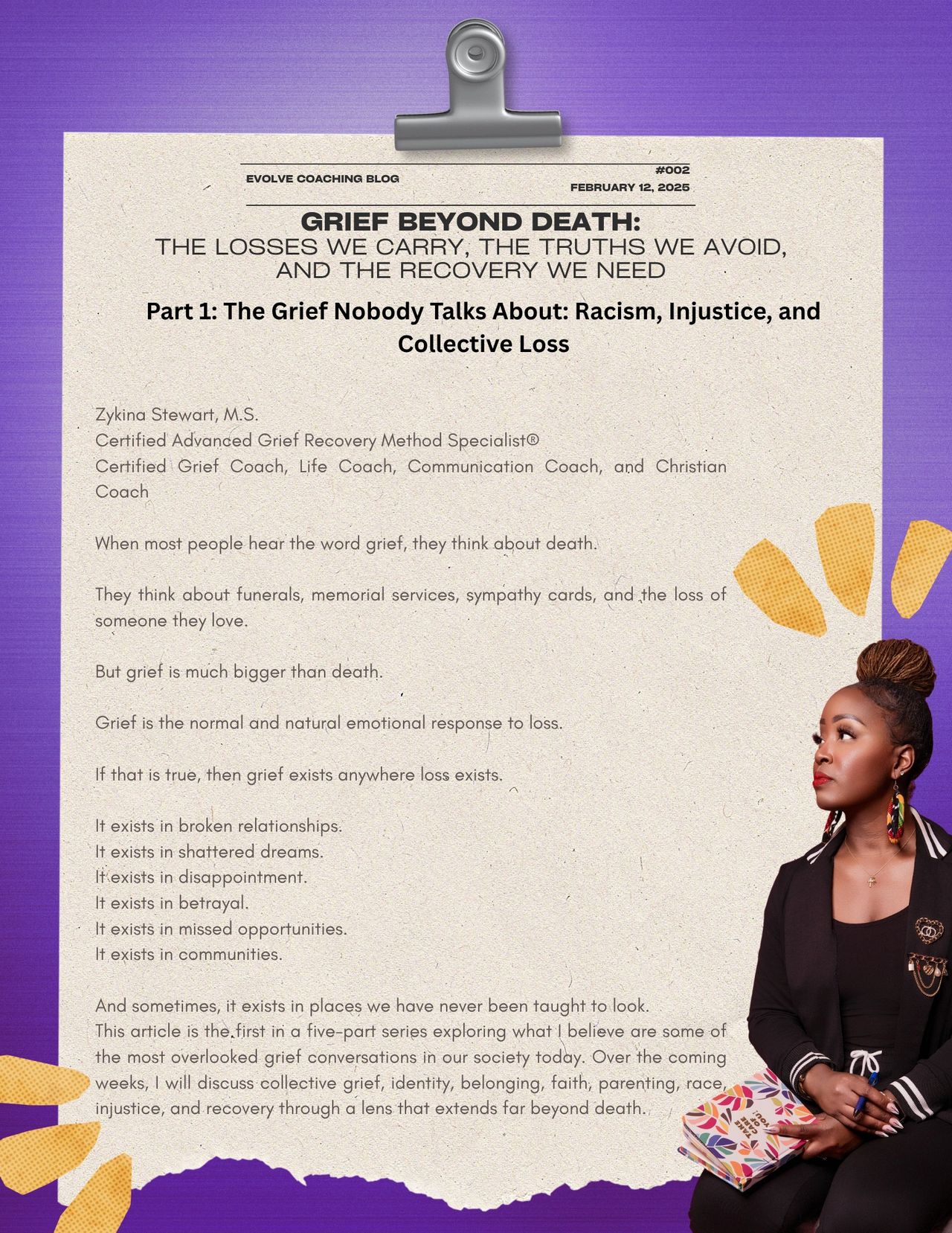
Grief Beyond Death: The Losses We Carry, The Truths We Avoid, and The Recovery We Need
Part 1: The Grief Nobody Talks About: Racism, Injustice, and Collective Loss
By Zykina Stewart, M.S. Certified Advanced Grief Recovery Method Specialist® Certified Grief Coach, Life Coach, Communication Coach, and Christian Coach
When most people hear the word grief, they think about death.
They think about funerals, memorial services, sympathy cards, and the loss of someone they love.
But grief is much bigger than death.
Grief is the normal and natural emotional response to loss.
If that is true, then grief exists anywhere loss exists.
It exists in broken relationships.
It exists in shattered dreams.
It exists in disappointment.
It exists in betrayal.
It exists in missed opportunities.
It exists in communities.
And sometimes, it exists in places we have never been taught to look.
This article is the first in a five-part series exploring what I believe are some of the most overlooked grief conversations in our society today. Over the coming weeks, I will discuss collective grief, identity, belonging, faith, parenting, race, injustice, and recovery through a lens that extends far beyond death.
My goal is to talk about grief.
Because as a grief coach, a Grief Recovery Specialist, and someone who has personally lived through profound loss, I believe many of the conversations we are having today are actually grief conversations, whether we recognize them as such or not.
And nowhere is that more evident than in conversations about racism, injustice, and collective loss.
A Mother's Fear
Yesterday, my son Carter was out riding his bike.
A little while later, I heard a loud, hurried knock at my front door.
I opened it to find one of his friends standing there yelling, "Carter is hurt! He crashed his bike!"
My heart immediately dropped into the pit of my stomach.
Without hesitation, I grabbed my keys and jumped into my car. As I drove down the street, my mind raced. My body shook. I prayed the entire way because I had no idea what I was about to find.
Every parent knows that feeling.
The fear.
The uncertainty.
The desperate need to get to your child.
When I arrived, I found him scraped up pretty badly. Thankfully, I could also tell he was going to be okay.
He was hurt.
He was shaken.
And he needed his mom.
I helped him into the front seat, loaded his bike into the trunk, thanked the boys who had helped him, and drove him home.
When we got there, the adrenaline began to wear off.
The emotions settled in.
At one point, he looked at me and said he didn't think he could get out of the car and walk into the house.
So I did what moms do.
I lifted my baby out of the seat and carried him inside.
Now, I realize Carter is almost twelve years old.
He's tall for his age.
Most people assume he's older than he is.
But in that moment, none of that mattered.
He was my son, my baby, my bubby.
He was hurting, scraped and bloody.
And I was determined to carry him to safety.
As I carried him through our front door, another thought entered my mind.
A thought that would not leave me.
Because while I was carrying my son to safety, another mother's son was heavy on my heart.
The verdict that had dominated conversations in my community was looming in my mind.
The images.
The reactions.
The heartbreak.
The fear.
The anguish.
And suddenly, I found myself realizing something that made my chest ache.
Not every parent gets to carry their child to safety after they have been scraped, bloodied, and traumatized.
Not every parent gets to rescue their child from what comes next.
Not every parent gets the opportunity to lift their child up and bring them into a place where they can feel protected.
That realization broke something open inside of me.
Why I Cried
If I am being completely honest, I do not consume every headline or follow every news story, especially in the current American climate, its traumatic.
But I knew the Karmelo Anthony verdict was coming.
And when it arrived, the image of his tears burns a hole in my heart because in that moment no one could rescue him from the impact of what would scar him for life. His mom could not carry him to safety, like I carried my son. I found myself emotional in a way that was hard to explain, but fully understood by those whose lived experience match mine.
I wasn't crying because it was one case.
I was crying because it touched a thousand losses.
The grief wasn't attached to a single moment.
It was attached to generations of moments.
It was attached to fears I carry as the mother of a Black son.
It was attached to questions I wish I didn't have to ask. It was attached seeing his tears after the verdict
What do I teach him now?
How do I prepare him?
How do I help him navigate a world where perception can become reality?
How do I teach him confidence without teaching him fear?
How do I teach him awareness without stealing his innocence?
What lessons are enough?
What lessons are too much?
For years, many Black families have had conversations about surviving interactions with law enforcement.
Now many parents find themselves wondering what other conversations they need to have.
What do we teach about conflict?
About bullying?
About self-defense?
About assumptions?
About navigating situations where outcomes do not always appear fair?
These are not simply political questions.
They are grief questions.
Because underneath them sits loss.
The loss of certainty.
The loss of safety.
The loss of trust.
The loss of believing that doing everything right guarantees a positive outcome.
We Talk About Trauma. We Rarely Talk About Grief.
When conversations about racism and injustice emerge, we often discuss trauma.
We discuss policies.
We discuss systems.
We discuss history.
We discuss social change.
Those conversations matter.
But there is another conversation happening underneath all of them.
The conversation about grief.
Grief that has accumulated over generations.
Grief connected to historical losses.
Grief connected to exclusion.
Grief connected to discrimination.
Grief connected to opportunities denied.
Grief connected to safety questioned.
Grief connected to humanity challenged.
Many communities are carrying losses that have never been fully acknowledged.
And grief that is never acknowledged rarely disappears.
Instead, it waits.
It resurfaces.
It connects today's pain to yesterday's wounds.
That is why certain stories affect people so deeply.
Because they are rarely responding only to today's event.
They are responding to accumulated loss.
Communities Remember Feelings
One of the things I have learned through grief recovery work is that people often remember how experiences felt long after they forget the details.
Communities do the same thing.
They remember fear.
They remember disappointment.
They remember betrayal.
They remember humiliation.
They remember heartbreak.
And every new event has the potential to reactivate emotions connected to previous losses.
Not because people are unwilling to move forward.
But because grief has a way of linking today's experiences with yesterday's wounds.
The Collective Grief We Don't Name
I often hear people ask why certain events produce such strong emotional reactions.
The answer may be simpler than we think.
Loss produces grief.
Repeated losses produce accumulated grief.
Generational losses produce collective grief.
And collective grief affects entire communities.
It influences how people interpret events.
It influences trust.
It influences fear.
It influences hope.
It influences expectations.
Yet we rarely discuss it.
Instead, we debate.
We argue.
We choose sides.
And in doing so, we often miss the emotional reality underneath the conversation.
There are grieving people on all sides of many of these issues.
And if we fail to recognize grief, we fail to understand what people are actually carrying.
Recovery Is Still Possible
The purpose of identifying grief is never to leave people trapped in it.
The purpose is understanding.
Because healing begins when we become honest about what we are carrying.
Healing begins when we stop pretending losses did not affect us.
Healing begins when we create language for experiences that have often remained unnamed.
As a Grief Recovery Specialist, I know something else to be true.
Loss is unavoidable.
Life will continue to bring disappointment, heartbreak, injustice, uncertainty, and change.
But grief does not have to become a permanent residence.
Recovery is possible.
Not because losses stop.
But because people can learn how to heal from them.
That truth matters for individuals.
It matters for families.
It matters for communities.
And it matters for future generations.
Because while losses may continue, recovery can continue too.
And that is a conversation worth having.
Communities don't only remember events. They remember how those events felt.
So I leave you with this question:
What losses have we ignored because we called them politics instead of grief?
Next in the Series
Part 2: The Grief of Moving Targets: When the Rules Keep Changing
In Part 2, I will explore the grief that can develop when people spend a lifetime adapting, code switching, proving themselves, and navigating constantly shifting expectations. We'll discuss authenticity, belonging, identity, and the emotional cost of feeling like acceptance is always conditional.
Empowering you to evolve.
Book a free interest session