
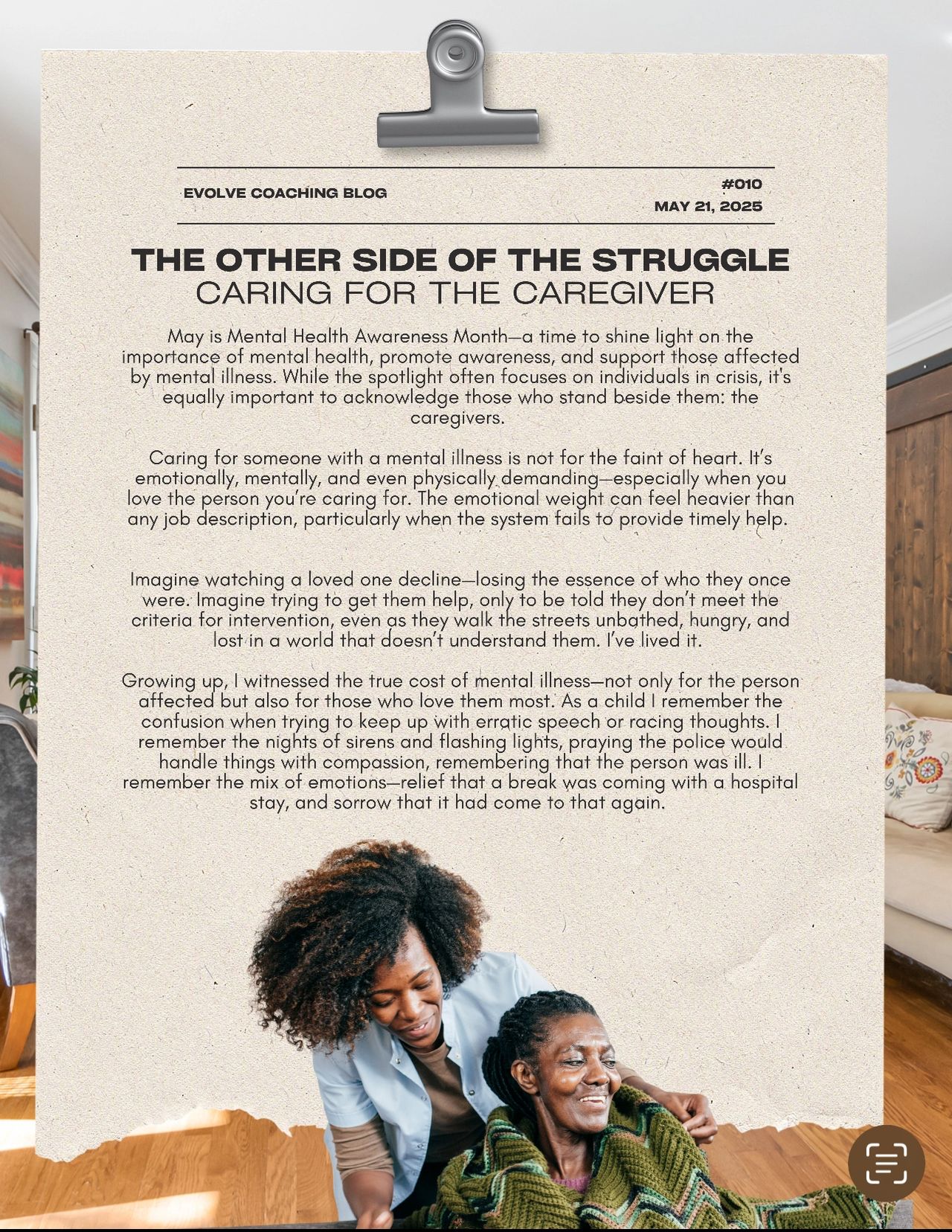
May is Mental Health Awareness Month-a time to shine light on the importance of mental health, promote awareness, and support those affected by mental illness. While the spotlight often focuses on individuals in crisis, it's equally important to acknowledge those who stand beside them: the caregivers.
Caring for someone with a mental illness is not for the faint of heart. It's emotionally, mentally, and even physically demanding-especially when you love the person you're caring for. The emotional weight can feel heavier than any job description, particularly when the system fails to provide timely help.
Imagine watching a loved one decline-losing the essence of who they once were. Imagine trying to get them help, only to be told they don t meet the criteria for intervention, even as they walk the streets unbathed, hungry, anc lost in a world that doesn't understand them. I've lived it.
Growing up, I witnessed the true cost of mental illness-not only for the person affected but also for those who love them most. As a child I remember the confusion when trying to keep up with erratic speech or racing thoughts. I remember the nights of sirens and flashing lights, praying the police would handle things with compassion, remembering that the person was ill. I remember the mix of emotions-relief that a break was coming with a hospital stay, and sorrow that it had come to that again.
Thankfully, I also witnessed success. Intervention, medication, programs, and community support made sustained stability possible. That journey pushed me to my degree in psychology, my need to help others and it gave me insight into the resilience it takes to be a caregiver-and why they need care too.
If you're a caregiver, hear me clearly: You matter. You are not invisible. And you are not alone.
5 Ways Caregivers Can Care for Their Own Mental Health
1. Give Yourself Permission to Feel
Caregiving is hard. It's okay to feel overwhelmed, frustrated, sad, or even angry.
Suppressing emotions doesn't make you strong-it makes you burnt out. Allow your self to be and feel human. Journal, talk to someone you trust, or seek professional counseling. Your emotions deserve space.
2. Set Boundaries Without Guilt
You cannot pour from an empty cup. Set clear emotional, physical, and time boundaries
-even with loved ones. Boundaries are not selfish; they are essential for long-term sustainability and sanity. To set proper boundaries that stick, you must be true to yourself about your personal capacity and what is going on. Understand what you are equipped to handle and what you are not.
3. Prioritize Rest and Routine
Chronic stress and sleep deprivation can wreak havoc on your mental and physical health. Schedule rest just like you would a doctor's appointment. Create daily routines that include moments of peace-whether it's a walk, a prayer, a nap, or deep breathing.
Do not skip these things because you think that they're not important. These are of the utmost importance!
4. Build a Support Team.
You weren't meant to do this alone. Reach out to other family members, friends, clergy, caregiving networks, or state assistance. Often, I hear from individuals that they don't have family support, and that they would rather not enlist the help of hired individuals, please note that you must do what is best to maintain your mental, physical or spiritual health and this may be what helps you. Consider joining support groups-either in person or online. Shared experiences can lighten the emotional load.
5. Stay Informed and Empowered
Education is a powertul tool. Understanding the condition your loved one is experiencing can ease fear and frustration. Learn about local programs, emergency protocols, mental health rights, and advocacy resources that can help both you and your loved one.
6. Stay Spiritually Fueled and Connected.
Stepping into the role of a caregiver often blurs the lines between our human limits and divine strength. It's essential to begin this journey with the understanding that the person you care for is ultimately a child of God, and He will always be their ultimate protector. Keeping this in mind, you must stay connected to the source of spiritual nourishment-God Himself. Strengthen your soul by immersing yourself in Scripture, devotional readings, church gatherings, and relationships with those who uplift your spirit. Remember to maintain a constant dialogue with God as you navigate this path, for He walks beside you, holding you up and shaping you into a greater version of yourself.
Being a caregiver means walking a vital path-a balance between compassion and endurance, consider your endurance with compassion. If no one has told you today: Thank you. You are doing an incredible job. You are not just a servant in someone else's story. You are a warrior, a hero, o witness, and a wellspring of love.
This Mental Health Awareness Month, take time to care for your mind, too. Your well-being matters just as much as the person you care for. Keep going, but not without rest and refueling. Keep loving, but not without support. And above all, never forget-you are seen, especially by God.
Empowering you to evolve.
Book a free interest session