
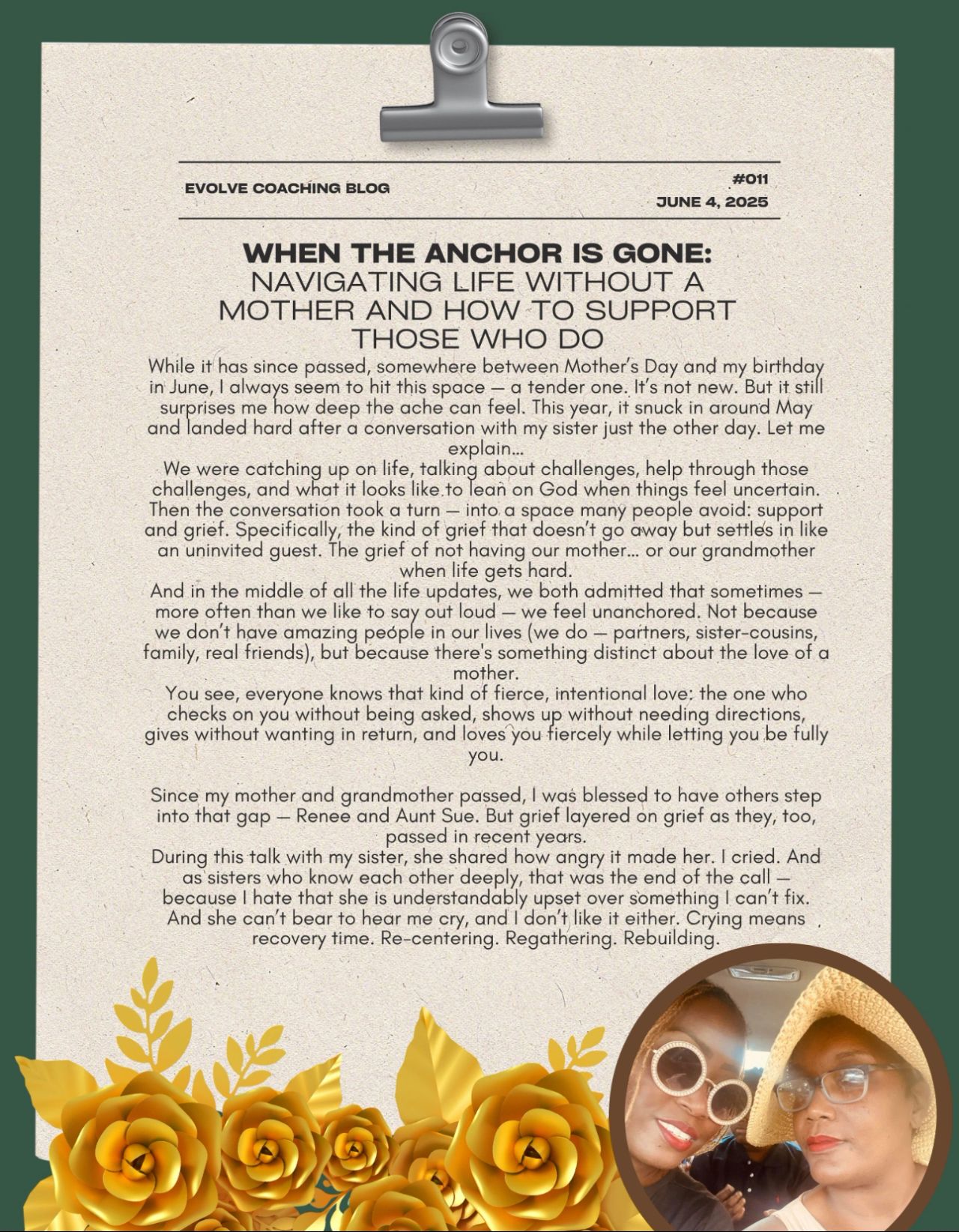
When the Anchor Is Gone: Navigating Life Without a mother and How to Support Those Who Do
While it has since passed, somewhere between Mother’s Day and my birthday in June, I always seem to hit this space — a tender one. It’s not new. But it still surprises me how deep the ache can feel. This year, it snuck in around May and landed hard after a conversation with my sister just the other day. Let me explain…
We were catching up on life, talking about challenges, help through those challenges, and what it looks like to lean on God when things feel uncertain. Then the conversation took a turn — into a space many people avoid: support and grief. Specifically, the kind of grief that doesn’t go away but settles in like an uninvited guest. The grief of not having our mother… or our grandmother when life gets hard.
And in the middle of all the life updates, we both admitted that sometimes — more often than we like to say out loud — we feel unanchored. Not because we don’t have amazing people in our lives (we do — partners, sister-cousins, family, real friends). But because there's something distinct about the love of a mother.
You see, everyone knows that kind of fierce, intentional love: the one who checks on you without being asked, shows up without needing directions, gives without wanting in return, and loves you fiercely while letting you be fully you.
Since my mother and grandmother passed, I was blessed to have others step into that gap — Renee and Aunt Sue. But grief layered on grief as they, too, passed in recent years.
During this talk with my sister, she shared how angry it made her. I cried. And as sisters who know each other deeply, that was the end of the call — Because I hate that she is understandibly upset over something I can’t fix. And, she can’t bear to hear me cry, and I don’t like it either. Crying means recovery time. Re-centering. Regathering. Rebuilding.
But now that I’ve processed those emotions, I wanted to share something for those of us living with this unique ache — and for those around us who want to love us better but may not know how.
For Those Without a Mother: Survival Steps When the Anchor Is Gone
1. Give Yourself Permission to Feel. Grief doesn't expire. It doesn't operate on a calendar. Let yourself feel what you feel — without guilt. Psalm 34:18 reminds us, “The Lord is close to the brokenhearted and saves those who are crushed in spirit.” Even in your most tender moments, you are not alone.
2. Journal Your Thoughts Honestly. Sometimes your head can’t make sense of what your heart is carrying. Writing out your thoughts — no filter — is a way to offload pain and process healing. God can handle the raw version of your truth.
3. Anchor Yourself in Truth. When you feel unanchored, go back to who God says you are. Isaiah 66:13 says, “As a mother comforts her child, so will I comfort you.” He sees the gap and fills it with divine care. Lean into that.
4. Create Rituals to Honor Them. Light a candle. Cook a favorite meal. Share a story. Celebrate their presence in your life instead of only mourning their absence. These small acts help keep the love alive in a healing way.
5. Ask for Support — and Be Specific. This one’s tough, especially for the strong ones. But healing sometimes looks like saying, “Hey, I need someone to check on me this week,” or “Can you just sit with me today?” You’re not a burden.
For the Support Circle: How to Show Up
1. Don’t Wait to Be Asked. Reach out. A simple text or call that says, “Thinking about you” can soften a hard day. Galatians 6:2 urges us to “carry each other’s burdens.” Even the smallest act of kindness counts.
2. Don’t assume that the person is supported.
Have you ever heard that you can’t judge a book by its cover? Yes, that saying is true. If you see that the person is surrounded by people, don’t assume that those are people that are anchors in their life. Also, just because the person does not ask for help, looks put together or appear to be emotionally well, do not assume that they are. Be open to the voice and nudging of God to be an “anchor” even if it looks different. Many people are often “surrounded” by others that aren’t
3. Ask Better Questions. Instead of “How are you?” try “What’s been heavy on your heart lately?” or “What’s something you wish someone would help you with right now?”
4. Offer Practical Love. Drop off coffee. Send a card. Sit in silence. Show up in ways that require no explanation. Sometimes ministry looks like presence, not platitudes.
5. Learn Their Grief Language. Some people need space. Some need distraction. Some want to talk. Others just want a hug. Ask, “What helps you feel loved when you’re missing your mom?”
6. Keep Showing Up. Not just in May. Not just around holidays. Consistent presence creates a new anchor of support. And, If they are mothers or fathers themselves, show up for their children. As a parent the biggest thing anyone can do for me is to also support my child. Remember if the motherless woman or woman does not have that support in their lives, then their child lacks the presence of a grandmother, and we all know the importance of grandmothers. Cheer on, check on, and be there for their children.
Final Thoughts
This journey without the woman who first carried you is not easy. It’s a path that feels lonelier at times than words can say. But you are not without love. You are not without God. You are not without hope.
To those walking this road — I see you. I am you. And to those standing beside us — thank you. Keep walking with us. We still need you.
Let’s choose compassion. Let’s give grace. Let’s anchor each other in love
Empowering you to evolve.
Book a free interest session